Showing posts with label salt. Show all posts

Saturday, 19 September 2026

Quesada Pasiega - a traditional dessert from Cantabria Spain

Today I show you the traditional recipe of 'quesada pasiega'. Being from Cantabria, I’ve tried every brand of quesada and also the traditional homemade ones made by a friend of my mother, who prepared them exquisitely. That’s why my standards for quesada are very high, and taking advantage of the blog, I wanted to try making one myself to see if I could achieve that delicious traditional flavor. And I did it!

Rest assured that if you follow the steps in my recipe, you’ll get all the traditional flavor of Cantabria.

The origin of quesada pasiega dates back to the 14th century, and its recipe has been passed down from parents to children until today. It was born in the area of Selaya, Vega del Pas, and Villacarriedo, created by shepherds who had leftover curdled milk and eggs and came up with this delightful dessert that soon became a hallmark of the entire province.


Quesada Pasiega - a traditional dessert from Cantabria Spain

Ingredients:

- 3 liters of fresh whole milk (to obtain 500 g of curdled milk or cheese).
- 200 g of sugar.
-100 g of butter.
-4 large eggs.
-A pinch of salt.
-100 g of regular flour or cake flour.
-3 teaspoons of ground cinnamon.
-Lemon zest.
-Rennet (the amount indicated by the manufacturer))


Preparation:

1- First, we prepare the curdled milk or queso pasiego. You need fresh milk; this recipe cannot be made with long-life milk from cartons—you must use the refrigerated milk sold in supermarket. The cheese obtained usually weighs about 1/4 of the amount of milk used. Pour all the milk into a pot and heat it to 34°C. I measured the temperature with a meat thermometer.


2- At this temperature, I added the drops of rennet indicated by the brand I bought. You can purchase rennet at pharmacies; I recommend buying the smallest amount possible because you won’t need much and it spoils quickly. For 3 liters of milk, I needed 60 drops. Stir well so the rennet spreads evenly throughout the milk.


3- I waited quite a while and nothing happened, so I gradually increased the temperature of the milk until, at 75°C, I saw it begun to curdle slightly. I continued raising it slowly up to 90°C, and at that point, it was clear that the milk had separated from the whey.

4- I turned off the heat, let the milk rest covered for two hours, then placed a strainer over a bowl with a cheesecloth on top and poured all the curdled milk onto it.


5- Lift the cloth and press the cheese slightly to release a bit more whey.


6- In a bowl, mix the butter with the sugar until you get a smooth paste.


7- Add the eggs, at room temperature, along with a pinch of salt, the cinnamon, and the lemon zest. Mix everything well.


8- Add the sifted flour using a strainer and mix thoroughly.


9- 
Incorporate the cheese and mix well. Some people blend it completely, but traditionally, small lumps of cheese are left. I kept a few lumps.


10- Grease a baking mold with butter and pour in the mixture. The baking mold has a diameter of 12 centimeters.


11- Preheat the oven to 200°C.

12- Place the quesada in the middle of the oven with heat above and below at 200°C for 8 minutes.

Then lower the temperature to 180°C and bake for another 35 minutes. After that, switch to heat above at the same temperature and bake for 10 more minutes—this helps the top brown nicely.

You can enjoy it warm or cold, whichever you prefer. It keeps well in the fridge, and the next day it tastes even better.


Receta en Español


You can also watch the recipe at my Youtube Channel:


Here you have my  favourite cooking tools: https://viaja-en-mi-cocina-english.blogspot.com/2023/05/shop.html


Flag of Cantabria (Official).svg
Cantabria


Por Miguillen - Trabajo propio, CC BY-SA 2.5, Enlace

Saturday, 12 September 2026

Monkfish - Cantabrian style

Monkfish is a fish commonly found on the rocky seabeds of the Cantabrian Sea. It is also known by the names pejesapo or pixín.

In the past, monkfish was often discarded at fish markets along the Cantabrian coast because of its unattractive appearance and oversized head. Over time, however, people discovered its delicate, white, flavorful flesh, which has since made it one of the most prized fish in the cuisine of Cantabria and northern Spain.

Today's recipe is one of the traditional ways monkfish is prepared in Cantabria.


Monkfish - Cantabrian style


Ingredients:

  • 750 g (1.65 lb) monkfish
  • 150 g (5 oz) shrimp
  • 250 g (9 oz) clams
  • 2 eggs
  • 1 sprig fresh parsley
  • 4 garlic cloves
  • 1 jar of asparagus
  • 1 tablespoon all-purpose flour
  • Olive oil
  • Salt

  • Instructions:

    1- Cut the monkfish into fillets or thick slices.

    2- Slice the garlic cloves. Using a mortar and pestle, crush the garlic together with the parsley and a pinch of salt until you have a paste.


    3- Rub the garlic and parsley mixture over both sides of the monkfish. Let it marinate for 30 minutes.


    4- Remove the excess garlic and parsley from the surface of the fish. Lightly coat the monkfish with flour, then dip it into the beaten eggs. Fry in hot olive oil until golden. Remove from the pan and place on paper towels to absorb any excess oil.


    5- Traditionally, this dish is prepared in a clay casserole, although a regular saucepan or casserole works just as well. Add a little olive oil over medium-low heat, then stir in the flour. Cook, stirring constantly, until the flour is completely dissolved. Pour in the liquid from the jar of asparagus and stir until the sauce is smooth and well combined.


    6- Add the monkfish, shrimp, and clams to the casserole. (The clams should have been soaked in salted water for a few hours beforehand to remove any sand.) Gently shake the casserole from time to time while cooking. Simmer for about 10 minutes, or until the sauce has thickened and the clams have opened.


    7- Add the asparagus cut into bite-sized pieces, add the hard-boiled eggs cut in half , and the dish is ready to serve!


    You can also watch the recipe at my Youtube Channel:


    Here you have my  favourite cooking tools: https://viaja-en-mi-cocina-english.blogspot.com/2023/05/shop.html

    Flag of Cantabria (Official).svg
    Cantabria


    Por Miguillen - Trabajo propio, CC BY-SA 2.5, Enlace

    Saturday, 21 May 2022

    Korokke from Palau

                                                                                    Receta en Español

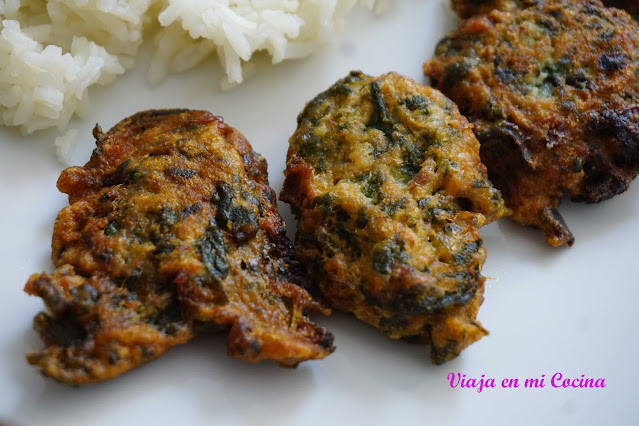
    Korokke are a kind of croquettes that are usually prepared in Palau, they come from the japanese cuisine and are eaten as snack or starter.

    This is the most widespread way to preparing Korokke in Palau, using a vegetable called water spinach.

    It is a difficult to find vegetable, but you can use spinachs instead of water spinachs.

    Korokke from Palaos


    Korokke Ingredients:

    - 2 tuna cans 113 g.
    - 300 grams spinachs.
    - Half an onion.
    - 4 tablespoon of soy sauce.
    - Salt.
    - 250 grams flour.
    - 2 eggs.
    - 2 cups of water.

    Sauce Ingredients:

    - Vinegar.
    - Chive.
    - Soy sauce.
    - Powdered garlic.
    - Powdered onion.


    Method:

    1- Wash and cut spinachs.
    2- Cut onion in little pieces.
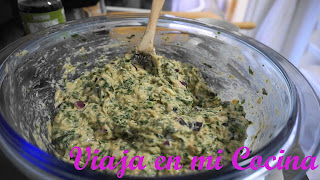
    3- Put spinachs in a bowl , add tuna and onion, mix well.


    4- Add the eggs, mix well.


    5- Add soy sauce.


    6- Add flour, mix well.


    7- Add water, salt and mix well.


    8- Take a frying pan, pour some oil and heat it. Once the oil is hot take a spoonful of the dough and pour it into the oil. Fry 4 minutes every side until they are golden.


    9- Put korokke on an absorbent paper to get rid of the excess of oil.

    10- Now we are going to make the sauce; mix vinager with the same quantity of soy sauce, add chive, salt, powdered garlic and onion.
    Mix well (instead of powdered onion I used little pieces of onion, but it is better to use the powder).
    This sauce is used to dip in the korokkes.


    You can complete the dish adding some white rice.


    Flag of Palau.svg
    Palau


    LinkWithin

    you might also like